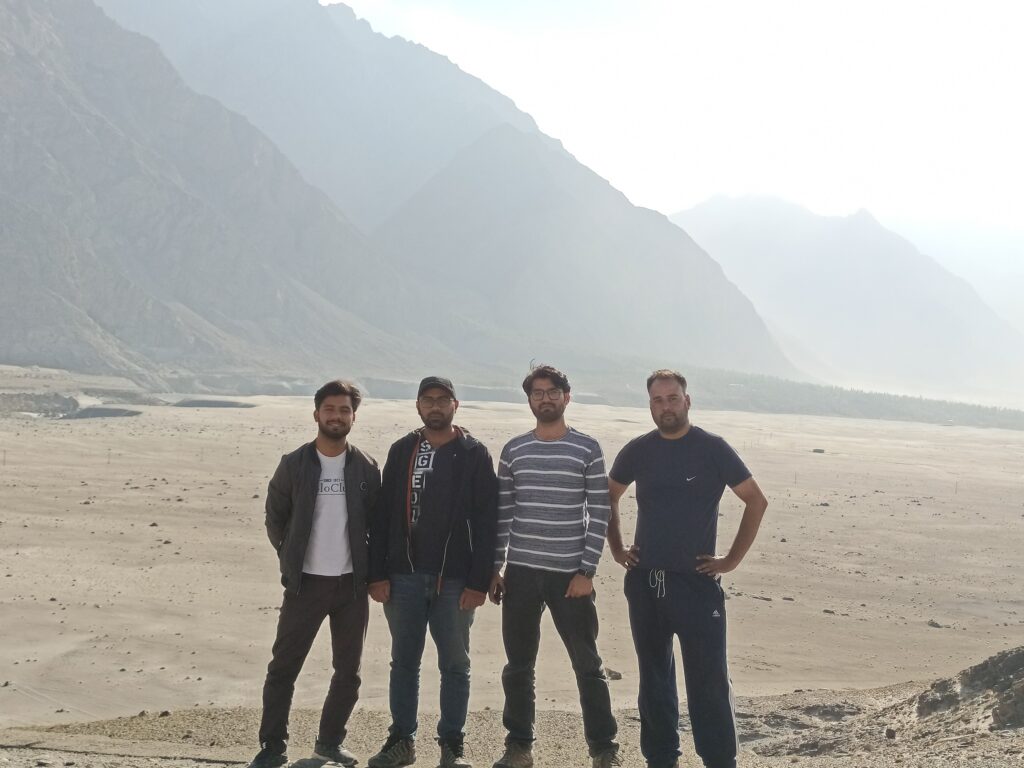

In September, we planned a trip to Skardu and its surrounding areas. However, due to work constraints, we could only allocate three days for this ambitious journey. Despite the time limitations, we embarked on a memorable adventure to Skardu on September 29th, 2021. This trip included the longest drive for me, from Khaplu to Islamabad without break.
We opted for the scenic Naran-Babusar-Chillas-Astore-Deosai-Skardu-Khalplu loop. This route offers the most diverse landscapes and iconic sites.
As midnight approached, we sped past Naran, fueled by my youthful vigor and a reckless disregard for sleep. Our plan was to push on, eager to explore the beauty of the road ahead. Little did we know, this decision would lead us into a perilous situation. When we finally halted at the serene Lulusar Lake, our car, like a weary traveler, refused to budge. The biting cold of the night, coupled with our lack of winter clothing, made our predicament even more dire. Thankfully, the compassionate people of Gilgit-Baltistan kept stopping for aid while passing through entire night, offering support. While two of us raced back to Naran to summon a mechanic, the rest of us huddled together, enduring the frigid night, forever grateful for the kindness of strangers.
The rest of us really enjoyed Lulusar and its surroundings, which I’d always overlooked on our trips north. In the morning, the lake became quite busy as many tourists joined us. Lulusar Lake is formed by the Kunhar River, which starts as a small stream before entering the lake. The Kunhar River originates from Sambasar Lake and the streams of Gittidas and Babusar. It’s my favorite river, especially the part before and after Lulusar Lake where it’s just a stream. I love the idea of wading into it and having a cup of tea while sitting on a rock.

While the mechanics from Naran worked on our car, we made tea and enjoyed it together.
After the car was repaired, we resumed our journey and arrived at Babusar Top. In my opinion, it’s one of the most stunning places I’ve ever seen. Whenever I visit Gilgit-Baltistan, I always make sure to stop here and take plenty of pictures.
We arrived in Astore, a town before the Deosai Plains, late at night. We checked into the River View Hotel and paid 1,850 rupees for the night, which included breakfast. The room itself cost 1,200 rupees.
Early in the morning, we set off for Deosai. After preparing our car, we embarked on our journey. While passing through Astore city, we noticed the Zarai Taraqiati Bank (ZTBL) branch. Intrigued, we decided to step inside and explore. We also captured a moment outside the bank.
We followed the Astore River, which originates from Sheosar Lake in Deosai. The journey was filled with stunning views that I tried to capture on my phone.
At noon, we arrived at Chilam Choki, the park entrance. To enter Deosai National Park, a fee is required. From this point, you can also access Minimarg, often mistakenly considered part of Astore, though it’s actually the last village in Pakistan-administered Kashmir. However, our destination was Skardu, so we continued our journey through the national park.
We arrived at Sheosar Lake, a stunning lake nestled in Deosai National Park, after an hour’s drive. We took a break to enjoy the scenery and capture some photos around the lake.
Beyond Sheosar Lake, vast, breathtaking plains stretch out, connected by a long dirt road. While most people explore this area in a 4×4 jeep, ordinary cars can also traverse it.
The Shigar River flows through the heart of the Deosai Plains. After visiting Sheosar Lake, you’ll encounter the river at Chota Pani, where you’ll need to cross it for the first time.
Beyond the Shigar River, the Deosai Plains stretch on. I couldn’t resist capturing their stunning beauty in photos.
You’ll cross the Shigar River again near Bara Pani or Kala Pani. These areas are popular camping spots, often bustling with other campers and tourists.
From Bara Pani, a dirt road leads to Deosai Top. While it might not look like a “top” from this side, the name comes from the more popular route: a jeep journey from Skardu, ascending through Sadpara Pass.
After this, I switched to video recording. We continued our journey past Sadpara village, where darkness began to fall. By the time we reached Skardu, it was night. Instead of stopping, we pressed on to Khaplu, our final destination. There, we stayed with a local family, cooked our own meals, and I braved the freezing water for a refreshing bath (which shocked others). After dinner, we retired for the night.
The next morning, we got ready for a hike to Thoksikhar Mosque or Thoksikhar View Point, located at the top of a mountain called . The path to the mosque is well-maintained with stone steps carved by locals, making the hike relatively easy. Safety grills are also installed at the top for added security.
After enjoying the Thoksikhar viewpoint, we visited the Twin Trees and Saling Bridge, capturing some memorable photos.
It was time to bid farewell to Khaplu and continue our journey to Skardu. Our next stop was the Sarfranga cold desert. On our way, we paused at several picturesque spots to capture the beauty of the landscape.
Finally, we arrived at Sarfranga cold desert. We spent some time there, admiring the scenery, attempting to drive in the sand, before heading back to Islamabad.
We planned to return home via the Karakoram Highway (KKH) to experience a different route and avoid potential snowfall at Babusar Top. However, our plans changed when we reached Jaglot and learned that the KKH was closed due to heavy landslides. Many travelers were stranded there, waiting for the road to reopen. We had to turn back after travelling more than a 100 km.
Due to safety concerns, we were not permitted to travel through Chillas at night and we had to wait at the Babusar entry point until morning. As soon as the sun rose, we headed towards the top, which was blanketed in the season’s first snow. The breathtaking view made the detour worthwhile, and we were grateful for the unexpected blessing.
We stopped at Gittidas for a tea break after leaving Babusar Top. I’ve always admired the Kunhar River, particularly the sections before and after Lulusar Lake. At Gittidas, the river is shallow enough to wade through, and we found a dry spot in the middle to enjoy our tea.
The “tea was fantastic”, but unfortunately, we had to leave for Islamabad. I ended up driving straight through the night. I started my journey from Khaplu at 9 AM on November 2nd and arrived in Islamabad at 2 PM on November 3rd. This was the longest continuous drive I’ve ever taken, and I thoroughly enjoyed it.
The 800 km trip typically takes 17 hours, but our many stops to explore different places along the way, as well as a 200 km detour to Babusar Pass, extended our travel time. However, these experiences created unforgettable memories.
On the return trip, there weren’t many photo opportunities after Balakot, so I focused on the drive and arrived home without further stops.


Worth reading.